
Local long-form writing
Autograph
Build the structure first, write the draft second.
Why it exists
Structure before linear draft
A long-form piece does not need to grow from beginning to end. Autograph treats headings as operable thought nodes so structure can be seen, moved, and discussed before it compiles into a linear article.
Traditional editors are good at continuous text, but make it difficult to hold global structure, local writing, and material boundaries at once. Autograph keeps one ordinary Markdown file as the source of truth and builds structural operations around it.
What it does
Capabilities verified against the release named above, stated only where source and interface evidence agree.
One file, no database
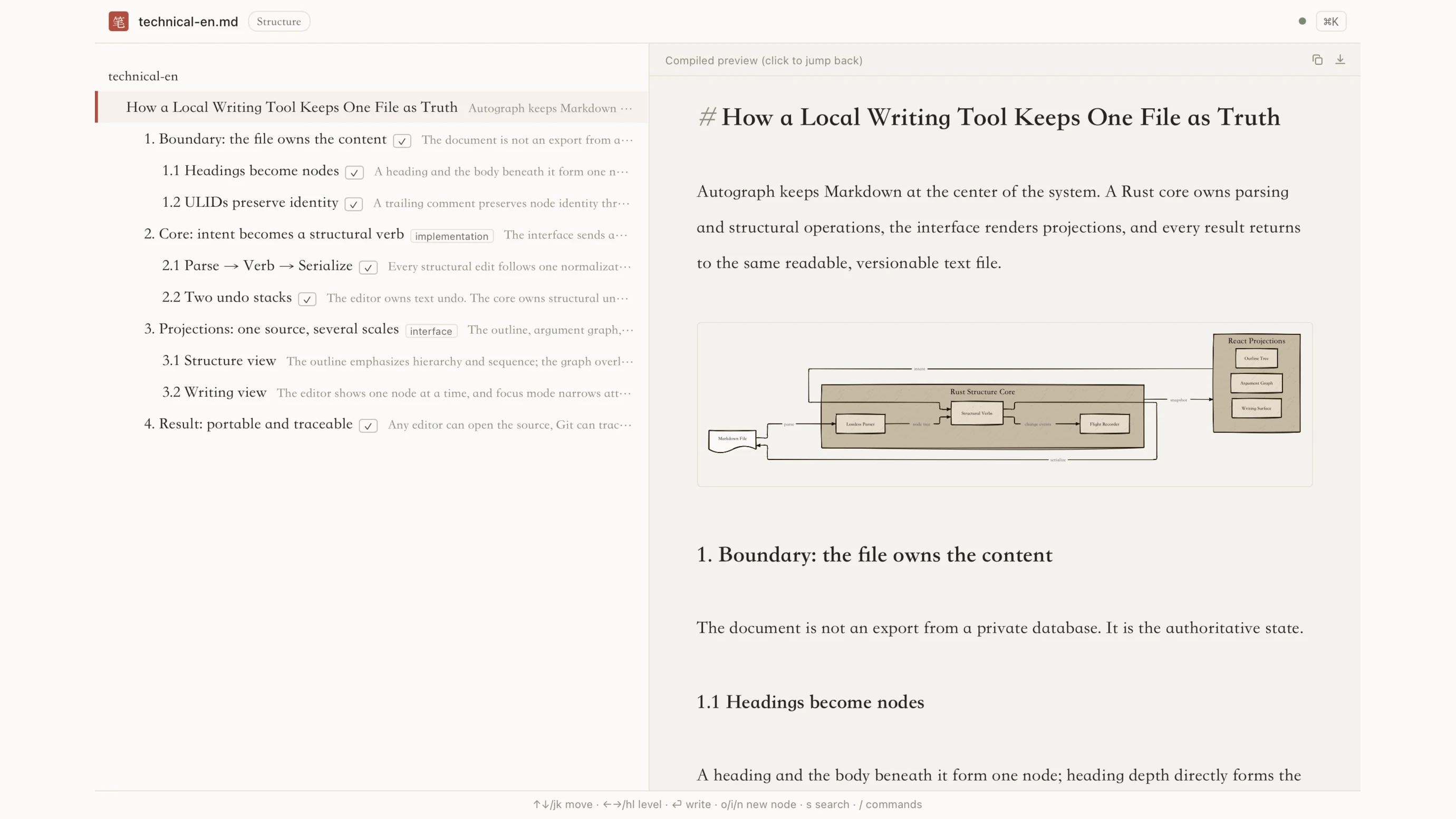
A heading and the body beneath it form one node, and heading depth is the spine. Node identity survives renaming and moving via a trailing comment on the heading line, while the file itself still opens in any Markdown editor.
Structure view: outline plus argument graph
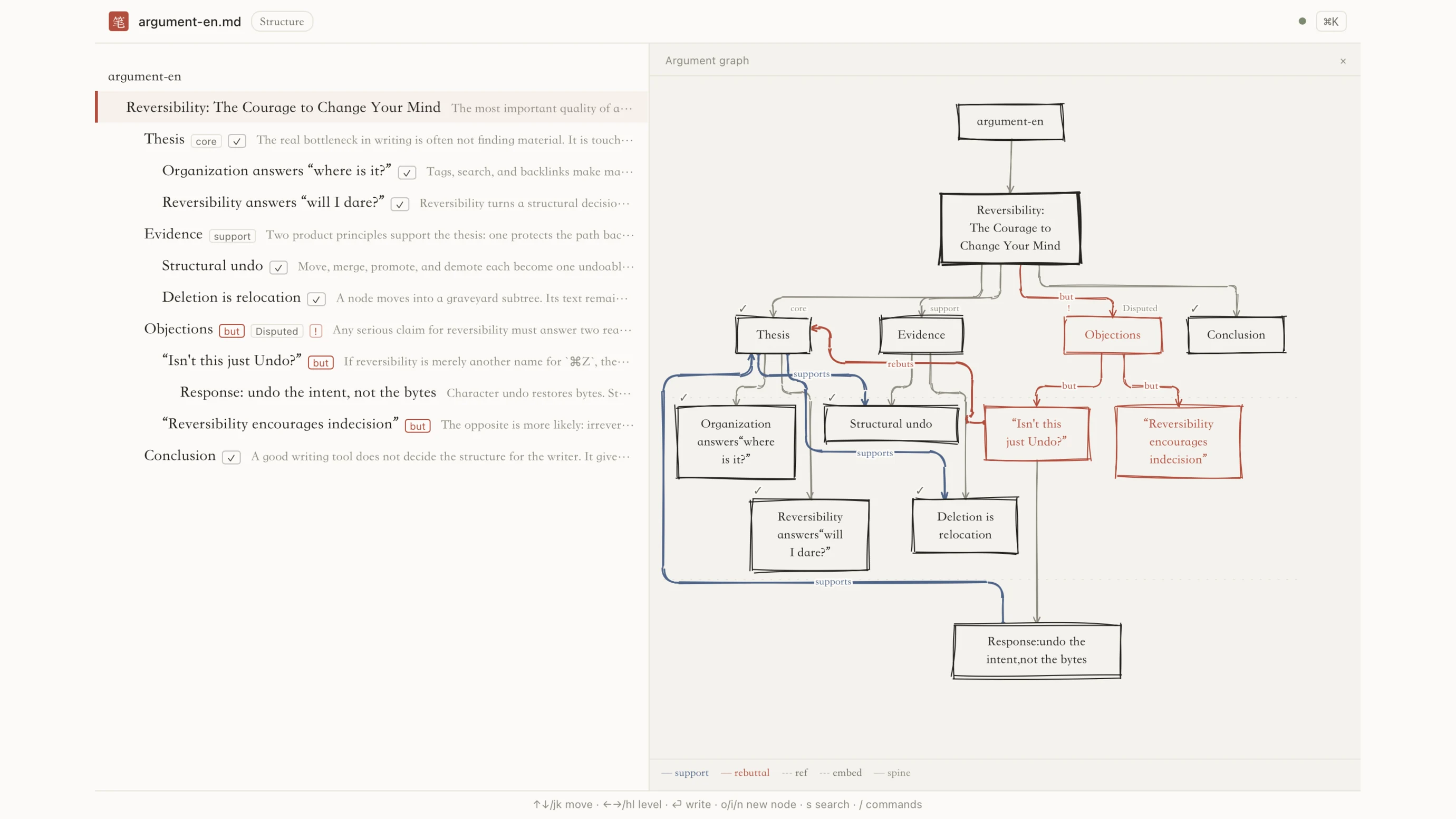
The outline emphasizes hierarchy and sequence. The argument graph redraws the same tree as support, rebuttal, and reference relations, so an unanswered objection stays on screen instead of disappearing mid-paragraph. The outline folds, and folding is view state — never written back to the file, never carried across documents; the cursor only ever moves along rows that are actually visible.
Structural verbs and two undo stacks
Move, merge, promote, and demote all pass through one Parse → Verb → Serialize path. The editor owns text undo and the core owns structural undo; deletion relocates a node into a graveyard subtree, where its text and references remain inspectable.
Writing view and focus mode
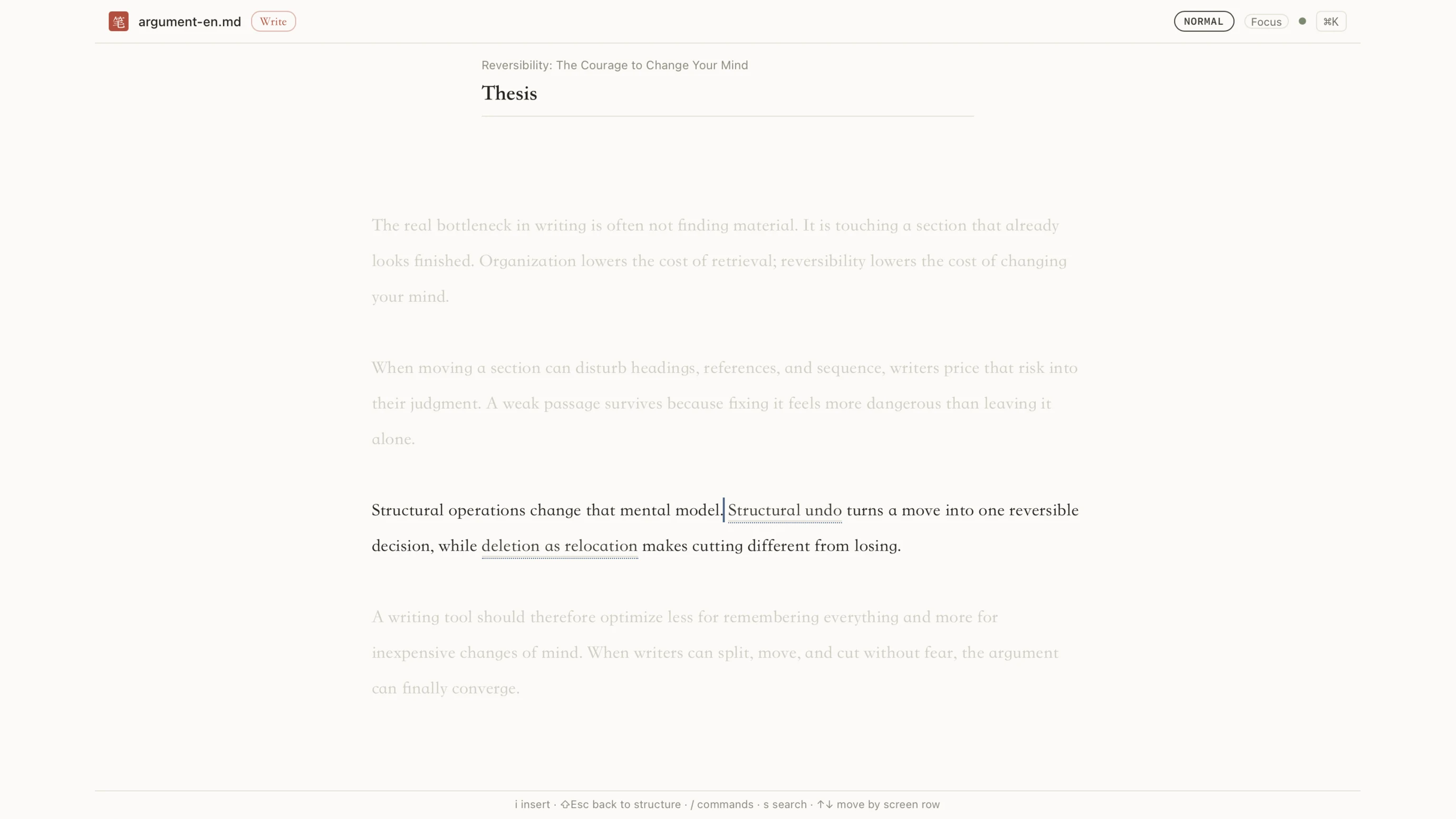
One node is edited at a time, and focus mode narrows attention further to the current paragraph while the rest fade without vanishing. Esc does exactly one thing: return to structure.
Compiled preview, click to jump back
The preview compiles the whole article depth-first, and clicking anywhere in it returns to the node that produced that text. Sequence exists only in that traversal — there is no second place where order is stored.
Asking the document what is unfinished
Six fixed checks: TK placeholders, nodes marked needs-work or still empty, hypotheses, counterarguments, captures still sitting in the inbox, and links whose target is gone. There is no query language to learn — the checks are the product. Any set of results can be projected back into the outline, leaving only the matches and the ancestor path needed to read them, with existing folds preserved untouched underneath. Every finding records the document opening and revision it was computed from and stops being valid the moment either changes, so it can never move the cursor into a document it no longer describes. The graveyard is not reviewed: discarded nodes are recoverable storage, not outstanding work.
Discussion cannot cross the author boundary
Discussions are anchored to nodes and archived separately. Only words the author writes in distill can enter the document body.
Evidence and limits
What makes this a product record rather than a speculative concept.
- A signed and notarized macOS DMG, publicly downloadable with a published SHA-256 checksum; source not public
- The current implementation supports single-file parsing, structural verbs, and compile mapping
- Multiple rounds of field feedback preserved in the changelog